

The month of APRIL in Roots, Blues & Rock History
Obscure, murky, contentious and discourteous bulletins that delve into the history of roots, blues and rock music thanks to some extensive and at times ill founded research by Dr Jerome Douvendahns.
Listen to the APRIL in Rock, Roots and Blues history podcast

Roots and Blues 2023 WINNERS
in the categories that matter!

Congratulations to 2023 Grammy Song of the Year winner ...
Bonnie Raitt for her song 'Just Like That'.
Yep she not only wrote the song but also played and sang it (unlike many of the other nominees).
Just looking at the categories ...Best songs, albums, performances etc for Rap, R&B, Pop, Dance Electronic, Metal, Rock, Folk even Comedy! There are Grammys for Best Progressive R&B and Best Traditional R&B. Traditional!?! I'm showing my age when I thought this related to Rhythm and Blues (à la Stax and Motown). The winner's album in this category opens with a barrage of mother f# this and mother f# that. Had to laugh, no Rhythm and Blues here what so ever.
Best Roots Gospel Album
WINNER: The Urban Hymnal — Tennessee State University Marching Band
Best American Roots Song
WINNER: "Just Like That" — Bonnie Raitt
Best Americana Album
WINNER: In These Silent Days — Brandi Carlile
Best Bluegrass Album
WINNER: Crooked Tree — Molly Tuttle & Golden Highway
Best Traditional Blues Album
WINNER: Get on Board — Taj Mahal & Ry Cooder
Best Contemporary Blues Album
WINNER: Brother Johnny — Edgar Winter
Best Folk Album
WINNER: Revealer — Madison Cunningham
Best Regional Roots Music Album
WINNER: Live at the 2022 New Orleans Jazz & Heritage Festival — Ranky Tanky
Best Historical Album
WINNER: Yankee Hotel Foxtrot (20th Anniversary Super Deluxe Edition)
Best Country Album
WINNER: A Beautiful Time — Willie Nelson


The Roots Music Report's
Top Blues Album Chart
for the Year of 2022
https://www.rootsmusicreport.com
| Album Title | Band/Artist Name | Label | |
|---|---|---|---|
| 1 | Outdated Emotion | Delbert McClinton | Hot Shot |
| 2 | May Be the Last Time | John Németh | NOLA Blues |
| 3 | Brother Johnny | Edgar Winter | Quarto Valley |
| 4 | That's My Name | Bob Stroger & The Headcutters | Delmark |
| 5 | Hard Times | John Primer | Blues House |
| 6 | Buchanan Lane | Yates McKendree | Qualified |
| 7 | Ace of Blues | Angela Strehli | New West |
| 8 | Bigman | Big Llou Johnson | Golden Voice |
| 9 | Thanks for Tomorrow | Harrison Kennedy | Electro-Fi |
| 10 | 75 and Alive | Johnny Tucker Featuring Kid Ramos And The Allstars | Blue Heart |
| 11 | Forever on My Mind | Son House | Easy Eye Sound |
| 12 | Nothing but the Blues | Eric Clapton | Reprise |
| 13 | Boogie Till I Die | Henri Herbert | HH |
| 14 | Crazy 'Bout You: a Tribute to Sonny Boy Williamson (feat. Mississippi MacDonald) | Steve Bailey | Another Planet |
| 15 | Still Here | Ben Levin | VizzTone |
| 16 | Rusty Ends Blues Band | Rusty Ends Blues Band | Earwig |
| 17 | Stripped Down in Memphis (feat. Kim Wilson & Wild Child Butler) | Big Jack Johnson | MC |
| 18 | Porch Sessions, Vol. 2 | Tony Holiday | Blue Heart |
| 19 | Lowell Fulson Live! | Lowell Fulson with Jeff Dale And The Blue Wave Band | Pro Sho Bidness |
| 20 | The Cause of It All | The Reverend Shawn Amos | Put Together |
| 21 | Live at Hermann’s | David Vest | Cordova Bay |
| 22 | Blues Medicine | Little Freddie King | MadeWright |
| 23 | 100 Years of Blues | Elvin Bishop & Charlie Musselwhite | Alligator |
| 24 | Hard Again | Muddy Waters | Sony |
| 25 | Baby Please Come Home | Jimmie Vaughan | The Last Music Company |
| 26 | New Moon Jelly Roll Freedom Rockers - Volume 2 | New Moon Jelly Roll Freedom Rockers | Stony Plain |
| 27 | For Love and Money | Harpdog Brown | Dog House |
| 28 | Bob Corritore & Friends: Spider in My Stew | Bob Corritore | VizzTone |
| 29 | Take Me Back | Kim Wilson | M.C. |
| 30 | Church of the Blues | Watermelon Slim | Northern Blues |
| 31 | Wasted Youth | Mick Kolassa | Endless Blues |
| 32 | Live at Rosa's | Linsey Alexander | Delmark |
| 33 | This is the Blues | Sheba the Mississippi Queen | Bongo Boy |
| 34 | Postcard from Beale Street | Eric Hughes Band | Endless Blues |
| 35 | Traveling Man (Live) | Watermelon Slim | Northern Blues |
| 36 | I Still Get Excited | Terry Hanck | VizzTone |
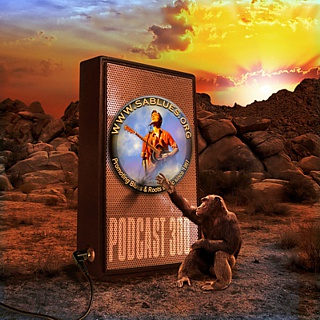
www.sablues.org presents its 300th podcast in April of 2018. 300! That is quite a landmark in the ephemeral comings and goings on the world wide web. Jerome Douvendahns since 2005 has been presenting podcasts with a playlist drawn from contemporary roots and blues releases. Things have certainly changed from the early days when punters would ask "what's a podcast?" to now receiving well over 2,000 downloads per month of each podcast. Listen to podcast 300 now. It includes a track from Adelaidian Emily Davis's latest album You, Me and the Velvet Sea. Jerome also reflects on the significance of 300 and presents 20 tracks for your listening pleasure.
INTERNATIONAL BLUES MUSIC DAY
The first Saturday in August of each year
On August 17, 2011 an online petition was launched advocating for the establishment of an International Blues Music Day. Within a few months the petition-group was joined by thousands of members from around the world, comprising of blues enthusiasts, musicians, celebrities, and promoters. After reaching 10,000 members, a formula for an annual date to celebrate IBMD was established as the first Saturday in August of each year with the inaugural celebration set to take place on August 3, 2013. The initiative was the brainchild of world renown blues musician Johnny Childs who also stars in the film The Junkman's Son and serves as the President of the NYC Blues Society. The IBMD organization and the NYC Blues Society are the lead nonprofit organizations charged with planning, promoting and producing this annual celebration.
http://www.internationalbluesmusicday.com
100 GREATEST CLASSIC BLUES SONGS
http://www.internationalbluesmusicday.com/blues-history.html
1. Memphis Blues - W.C. Handy
2. Crazy Blues - Mamie Smith
3. Pine Top Boogie - Pine Top Smith
4. Dust My Broom - Elmore James
5. Boogie Chillun - John Lee Hooker
6. Mannish Boy - Muddy Waters
7. Stormy Monday - T-Bone Walker
8. Hellhound On My Trail - Robert Johnson
9. Spoonful - Willie Dixon
10. The Thrill Is Gone - B.B. King
11. Good Morning Little Schoolgirl - Sonny Boy Williamson I
12. Born Under A Bad Sign - Albert King
13. Forty Four Blues - Roosevelt Sykes
14. Smokestack Lightnin' - Howlin' Wolf
15. Statesboro Blues - Taj Mahal
16. Hoochie Coochie Man - Muddy Waters
17. Juke - Little Walter
18. The Little Red Rooster - Willie Dixon
19. Come In My Kitchen - Robert Johnson
20. I'm a King Bee - Slim Harpo
21. The Things That I Used To Do - Guitar Slim
22. Back Door Man - Willie Dixon
23. It's My Own Fault - B.B. King
24. I'm Tore Down - Freddie King
25. T-Bone Blues - T-Bone Walker
26. Sweet Home Chicago - Robert Johnson
27. Preaching The Blues - Son House
28. Nobody Knows You When You're Down & Out - Bessie Smith
29. I Can't Be Satisfied - Muddy Waters
30. Shake Your Moneymaker - Elmore James
31. Matchbox Blues - Blind Lemon Jefferson
32. Hideaway - Freddie King
33. How Long, How Long Blues - Leroy Carr & Scrapper Blackwell
34. Five Long Years - B.B. King
35. Red House - Jimi Hendrix
36. Cross Road Blues - Robert Johnson
37. All Your Love - Magic Sam
38. Give Me Back My Wig - Hound Dog Taylor
39. Reconsider Baby - Lowell Fulson
40. Worried Life Blues - Sleepy John Estes
41. If Trouble Was Money - Albert Collins
42. I Ain't Superstitious - Willie Dixon
43. Sweet Black Angel - Robert Nighthawk
44. I Know What You're Putting Down - Louis Jordan
45. Black Snake Moan - Blind Lemon Jefferson
46. Ball and Chain - Big Mama Thornton
47. Further On Up The Road - Bobby 'Blue' Bland
48. I Can't Quit You Baby - Otis Rush
49. Boom Boom - John Lee Hooker
50. Born In Chicago - Paul Butterfield Blues Band
51. Let The Good Times Roll - Louis Jordan
52. Pride and Joy - Stevie Ray Vaughan
53. Pony Blues - Charley Patton
54. The Sky Is Crying - Elmore James
55. Catfish Blues - Robert Petway
56. Highway 49 - Big Joe Williams
57. See That My Grave Is Kept Clean - Blind Lemon Jefferson
58. Blues Before Sunrise - Leroy Carr & Scrapper Blackwell
59. Baby Please Don't Go - Big Joe Williams
60. Bumble Bee - Memphis Minnie
61. I'm Ready - Muddy Waters
62. It Hurts Me Too - Elmore James
63. Stop Breakin' Down - Robert Johnson
64. Texas Flood - Stevie Ray Vaughan
65. I'm In The Mood - John Lee Hooker
66. Me and The Devil Blues - Robert Johnson
67. The Walkin' Blues - Taj Mahal
68. 'Taint Nobody's Bizness If I Do - Bessie Smith
69. It's Tight Like That - Tampa Red
70. Love In Vain - Robert Johnson
71. Evil - Willie Dixon
72. Baby Scratch My Back - Slim Harpo
73. Wang Dang Doodle - Koko Taylor
74. On The Road Again - Canned Heat
75. Rock Me Mama - Arthur 'Big Boy' Crudup
76. Three O'Clock Blues - B.B. King
77. Tomorrow Night - Lonnie Johnson
78. Boom Boom Out Go The Lights - Little Walter
79. The Same Thing - Willie Dixon
80. West Coast Blues - Blind Blake
81. How Many More Years - Howlin' Wolf
82. Cryin' Shame - Lightnin' Hopkins
83. Rollin & Tumblin - Elmore James
84. Everyday I Have The Blues - B.B. King
85. Messin Around - Memphis Slim
86. Blues After Hours - Pee Wee Crayton
87. Eyesight To The Blind - Sonny Boy Williamson II
88. CC Rider - Ma Rainey
89. I'm Tired - Savoy Brown
90. Graveyard Dream Blues - Ida Cox
91. Beaver Slide Rag - Peg Leg Howell
92. Key To The Highway - Big Bill Broonzy
93. Messin' With The Kid - Junior Wells
94. The Seventh Son - Willie Dixon
95. As The Years Go Passing By - Gary Moore
96. We're Gonna Make It - Little Milton
97. Drinking Wine Spo-Dee-O-Dee - Stick McGhee
98. Hard Luck Blues - Roy Brown
99. Black Magic Woman - Fleetwood Mac
100. Stone Crazy - Buddy Guy
1. King Of The Delta Blues - Robert Johnson
2. West Side Soul - Magic Sam
3. Born Under A Bad Sign - Albert King
4. I Am The Blues - Willie Dixon
5. A Man and The Blues - Buddy Guy
6. Hoodoo Man Blues - Junior Wells & Buddy Guy
7. Fathers And Sons - Muddy Waters
8. Moanin' In The Moonlight - Howlin' Wolf
9. Texas Flood - Stevie Ray Vaughan
10. Dance With Freddie King - Freddie King
11. Bluesbreakers with Eric Clapton - John Mayall
12. The Gate Of The Horn - Memphis Slim
13. The Paul Butterfield Blues Band - Paul Butterfield
14. Coffee Blues - Mississippi John Hurt
15. The Natch'l Blues - Taj Mahal
16. It Serves You Right To Suffer - John Lee Hooker
17. Spotlight On Lucille - B.B. King
18. Blues After Hours - Elmore James
19. I Do Not Play No Rock and Roll - Mississippi Fred McDowell
20. Completely Well - B.B. King
21. Couldn't Stand The Weather - Stevie Ray Vaughan
22. Down and Out Blues - Sonny Boy Williamson
23. Confessin' The Blues - Little Walter
24. Johnny Winter - Johnny Winter
25. King of The Blues Guitar - Albert King
26. Can't Get No Grindin' - Muddy Waters
27. T-Bone Blues - T-Bone Walker
28. Howlin' Wolf - Howlin' Wolf
29. Ice Pickin' - Albert Collins
30. Roy Buchanan - Roy Buchanan
31. One More Mile - Clarence "Gatemouth" Brown
32. Bonanza of Instrumentals - Freddie King
33. English Rose - Fleetwood Mac
34. From The Cradle - Eric Clapton
35. I Feel Like Goin' On - Ronnie Earl
36. I'll Play The Blues For You - Albert King
37. Blues Singer - Buddy Guy
38. Raw Sienna - Savoy Brown
39. Hard Again - Muddy Waters
40. Natural Boogie - Hound Dog Taylor
41. Taj Mahal - Taj Mahal
42. A Hard Road - John Mayall
43. Progressive Blues Experiment - Johnny Winter
44. Hawk Squat - J.B. Hutto
45. Stand Back - Charlie Musselwhite
46. Showdown - Albert Collins, Robert Cray & Johnny Copeland
47. The Wham of That Memphis Man - Lonnie Mack
48. Bad News Is Coming - Luther Allison
49. Long Way Home - Clarence "Gatemouth" Brown
50. Third Degree - Johnny Winter
51. In Step - Stevie Ray Vaughan
52. Nothin But The Blues - Johnny Winter
53. The Resurrection of Pigboy Crabshaw - Paul Butterfield Blues Band
54. Two Steps From The Blues - Bobby "Blue" Bland
55. Alone & Acoustic - Buddy Guy & Junior Wells
56. Boogie With - Canned Heat
57. Blues On The Bayou - B.B. King
58. I'm A Blues Man - Z.Z. Hill
59. The Colour Of Love - Ronnie Earl
60. Chicago Bound - Jimmy Rogers
61. Double Time - Leon Redbone
62. Delta Blues - Son House
63. Hard Time Killing Floor Blues - Skip James
64. Dark Was The Night - Blind Willie Johnson
65. Beginnings - The Allman Brothers
66. Otis Spann is the Blues - Otis Spann
67. Mississippi Fred McDowell - Mississippi Fred McDowell
68. Singin' The Blues - B.B. King
69. East West - Paul Butterfield
70. Alright Again - Clarence "Gatemouth" Brown
71. Move It On Over - George Thorogood
72. Riding With The King - B.B. King & Eric Clapton
73. Right Place, Wrong Time - Otis Rush
74. At Last - Etta James
75. Endless Boogie - John Lee Hooker
76. Slideways - Roy Rogers
77. Girls Go Wild - The Fabulous Thunderbirds
78. Cold Snap - Albert Collins
79. Strike Like Lightning - Lonnie Mack & Stevie Ray Vaughan
80. Still Got The Blues For You - Gary Moore
81. Strong Persuader - Robert Cray
82. Slippin' In - Buddy Guy
83. Crusade - John Mayall
84. Roll Away The Stone - Kelly Joe Phelps
85. The Son Seals Blues Band - Son Seals
86. After Hours - Gary Moore
87. Lead Me On - Kelly Joe Phelps
88. Original Fleetwood Mac - Fleetwood Mac
89. T-Bird Rhythm - The Fabulous Thunderbirds
90. Gate Swings - Clarence "Gatemouth" Brown
91. Indianola Mississippi Seeds - B.B. King
92. Hooker & Heat - John Lee Hooker & Canned Heat
93. Black Magic - Magic Sam
94. Stone Crazy - Buddy Guy
95. Houserockin' - Hound Dog Taylor
96. Mr. Scrapper's Blues - Scrapper Blackwell
97. White African - Otis Taylor
98. Hard Drivin' Blues- Roosevelt Sykes
99. Koko Taylor - Koko Taylor
100. Relentless - Danny Gatton
Explore these obscure, murky, contentious and discourteous bulletins
that delve into the history of roots, blues and rock music
thanks to some extensive and at times ill founded research
by Dr Jerome Douvendahns.
JANUARY events in the history of Rock Roots and Blues music.
FEBRUARY events in the history of Rock Roots and Blues music.
MARCH events in the history of Rock Roots and Blues music.
APRIL events in the history of Rock Roots and Blues music.
MAY events in the history of Rock Roots and Blues music.
JUNE events in the history of Rock Roots and Blues music.
JULY events in the history of Rock Roots and Blues music.
AUGUST events in the history of Rock Roots and Blues music.
SEPTEMBER events in the history of Rock Roots and Blues music.
OCTOBER events in the history of Rock Roots and Blues music.
NOVEMBER events in the history of Rock Roots and Blues music.
DECEMBER events in the history of Rock Roots and Blues music.
Adelaide Roots & Blues Association
ARBA on the web
ARBA on Facebook
ARBA's The Album of the Year Awards recognise, acknowledge and promote the many fine roots and blues albums recorded and released by South Australian acts every year. As is the tradition at sablues.org a future podcast will be devoted to presenting a track from each of the entries so stay tuned!
Listen to a selected track from each entry
2023 Roots entries
Artist Craig Atkins
Album Head Above Water
Artist Alana Jagt
Album Goodbye Grote Bollen
Artist Kaurna Cronin
Album Harsh Beauty
Artist The Black Valley Scribes (The Boogie Men)
Album Katies Lane
Artist History of Trees (Nick Kipridis)
Album Observatory Lane
Artist Ryan Martin John
Album Goodness Gracious Graceless
Artist Goldstein
Album Unsung Folk (Volume One)
Artist The Yearlings
Album Luck
2023 Blues entries
Artist Union Trading Company
Album Hand Made
Artist Cal Williams Jr Trio
Album Black Mountain
Artist Ella Ion
Album Waiting
Album Toetappin’
Listen to a selected track from each album.
AUSTRALIAN BLUES & ROOTS AIRPLAY CHART
Here are the 25 most-played new and reissued CD's from Australian Blues & Roots artists
Monthly Chart #168 - DECEMBER
Place This Month/Place Last Month / No. of months in the charts (as of start of October) / Artist / Album / Label / Year / Website
1 / 1 / 2 / MITCH GRAINGER / Plug It In / Independent / 2023 / www.mitchgrainger.com
2 / 2 / 4 / SHANE PACEY TRIO / Who Made You King? / Independent / 2023 / https://shanepaceytrio.com.au
3 / 4 / 2 / MARK EASTON / Nothing's Sacred / Independent / 2023 / www.markeaston.net
4 / new / new / CHECKERBOARD LOUNGE / Rollercoaster / Cheersquad / 2023 / https://checkerboardlounge.com.au
5 / 8 / 7 / LLOYD SPIEGEL / Bakehouse Dozen / Independent - Only Blues Music / 2023 / www.lloydspiegel.com
6 / 19 / 2 / CLAYTON DOLEY / Optimistic / Interface Blue / 2023 / www.claytondoley.com
7 / 7 / 4 / THE BLOW OUT / Version of You / Independent / 2023 / https://theblowout.net
8 / 5 / 6 / KEVIN BORICH / Duets / Independent / 2023 / www.kevinborich.com.au
9 / 3 / 4 / ROD PAINE & THE FULLTIME LOVERS / Dirt on Velvet / Independent / 2023 / www.facebook.com/RodPainesFulltimeLovers
10 / 13 / 9 / 8 BALL AITKEN / Ice Cream Man 2 / Independent / 2023 / www.8ballaitken.com
11 / 39 / new / SIMON KINNY-LEWIS / Deep Cut / Independent - SKL Music / 2023 / www.sklblues.com
12 / 15 / 9 / FIONA BOYES / Ramblified / Blue Empress / 2023 / www.fionaboyes.com
13 / 12 / 8 / LIZA OHLBACK / Unravelling / Independent / 2023 / www.lizaohlback.com
14 / 10 / 3 / JACK DERWIN & FRIENDS / Digging Up The Roots Vol 1 / Independent / 2023 / https://jackderwintheraggedgents.bandcamp.com/album/digging-up-the-roots-vol-1
15 / 9 / 4 / RUSSELL MORRIS / The Real Thing - Symphonic Concert / Ambition Records / 2023 / www.russellmorris.com.au
16 / 26 / 4 / THE TESKEY BROTHERS / The Winding Way / Ivy League-Mushroom group / 2023 / www.theteskeybrothers.com
17 / 39 / 2 / EDDY & THE EXCITERS / Eddy & The Exciters - EP / Independent / 2023 / www.facebook.com/EddyExciters
18 / 31 / 5 / DAMON SMITH / A Fresh Harvest from Old Seeds / Independent / 2023 / www.damonmarcsmith.com
19 / 25 / 8 / HARPO WALKER / Bruised Heart Blues / Big Rock Records / 2023 / www.harpowalker.com
20 / 6 / 6 / RAY BEADLE / Bound to Get the Blues / Interface Blue / 2023 / www.raybeadleband.com
21 / new / new / AARON POLLOCK / Live! / Independent / 2023 / www.aaronpollockmusic.com
22 / 16 / 2 / ASH GRUNWALD / The Bluesfest Studio Sessions / Delta Groove - Bloodlines / 2023 / www.ashgrunwald.com
23 / 26 / 6 / FRANK SULTANA / The Ghosts of Sun / Independent / 2023 / www.facebook.com/FrankSultanaMusic
24 / 11 / 3 / KEITH HALL BAND / Blue and Indigo / Independent / 2023 / www.keithalanhall.com.au
25 / 17 / 3 / PHIL COYNE & THE WAYWARD ACES / Sound & Fury / Independent / 2023 / www.facebook.com/philcoyneandthewaywardaces

4th Annual Blues Music Award Winners
May 12, 2023
Acoustic Blues Album – Charlie Musselwhite – Mississippi Son
Acoustic Blues Artist – Doug MacLeod
Album of the Year – Buddy Guy – The Blues Don’t Lie
B.B. King Entertainer – Tommy Castro
Band of the Year – Tedeschi Trucks Band
Best Emerging Artist Album – Dylan Triplett – Who is He?
Blues Rock Album – Albert Castiglia – I Got Love
Blues Rock Artist – Albert Castiglia
Contemporary Blues Album – Buddy Guy – The Blues Don’t Lie
Contemporary Blues Female Artist – Ruthie Foster
Contemporary Blues Male Artist – Christone “Kingfish” Ingram
Instrumentalist-Bass – Danielle Nicole
Instrumentalist-Drums – Kenny “Beedy Eyes” Smith
Instrumentalist-Guitar – Laura Chavez
Instrumentalist-Harmonica – John Németh
Instrumentalist-Horn – Deanna Bogart
Instrumentalist Pinetop Perkins Piano Player – Anthony Geraci
Instrumentalist-Vocals – Shemekia Copeland
Song of the Year – “The Blues Don’t Lie” written by Tom Hambridge
Soul Blues Album – Sugaray Rayford – In Too Deep
Soul Blues Female Artist – Thornetta Davis
Soul Blues Male Artist – Curtis Salgado
Traditional Blues Album – John Németh – May Be the Last Time
Traditional Blues Female Artist Koko Taylor Award – Sue Foley
Traditional Blues Male Artist – John Primer

June 2022
The 25th Annual Maple Blues Award Winners
Male Vocalist of the Year
Colin James
Female Vocalist of the Year
Miss Emily
Drummer of the Year
Lindsay Beaver
Keyboard Player of the Year
David Vest
New Artist /Group of the Year
The Lowdown Dirty Mojos
Blues Booster of the Year (tied)
Claude Cloutier & Terry Parsons
Acoustic Act of the Year
Steve Marriner/David Gogo
Electric Act of the Year
Colin James
Harmonica Player of the Year
Steve Marriner
Horn Player of the Year
Allison Young
Guitarist of the Year
Sue Foley
Bassist of the Year
Keith Picot
International Artist of the Year
Bonnie Raitt
Recording/ Producer of the Year
Steve Marriner - Hope Dies Last (Stony Plain)
Blues With A Feeling Award (Lifetime Achievement Award)
Shakura S'Aida
Songwriter of the Year
Steve Marriner
Entertainer of the Year
Sue Foley
The music of the Blues, whilst originating in the South of the USA, has long ago taken root in Australia. Supported with equal levels of passion and commitment, by fans, musicians and the general public. However, Blues Music in Australia is overlooked by the mainstream media. It is generally ignored by Music Industry bodies such as AIR and ARIA, and the various music showcases. The genre, along with dedicated Blues artists, rarely feature. In Australia, there are many Blues musicians and over 10 Blues Societies. These organisations support the music and musicians, organise events such as Blues Performerof 2011-12 competitions, conduct events such as Youth in Blues programs and host their own music awards.
To promote Blues music, and musicians in Australia, it is proposed that we have an annual Blues Music Day. On this day, it is envisaged that gigs will be organised, radio programs will feature blues artists and music and Blues Societies will organise various events to celebrate the day. All of these activities will be promoted under the banner of Blues Music Day.
The date chosen is 29th August, the birth date of the recently deceased Australian Blues man, Dutch Tilders. Dutch, who did so much to foster Blues music and encourage fellow musicians in this country, will be honoured in this way.
Join the group:
http://www.facebook.com/groups/

Bit of history here! Cleaned out the study recently and uncovered the 1999 South Australian Blues Society's wedsite.
...so this is what was happening over 20 years ago as far as blues in Adelaide goes! It's a time capsule worth viewing!
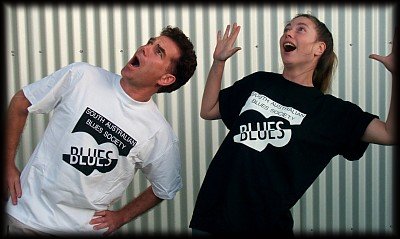
Discovered in the archives! Have a read of some of the BLUES NEWS issues from 2003-4!
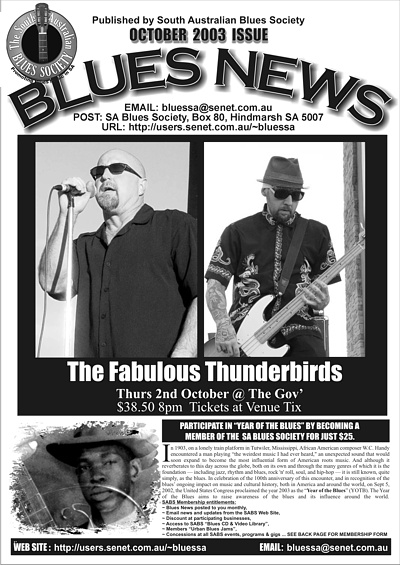
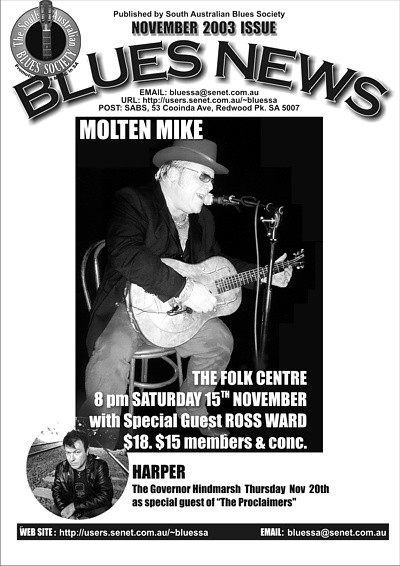
Blues News Nov 2003 PFD
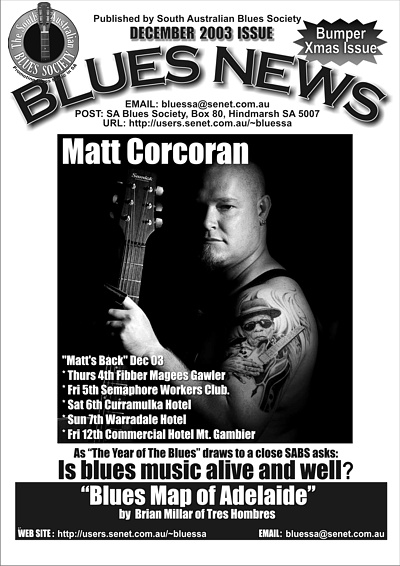
Blues News Dec 2003 PDF
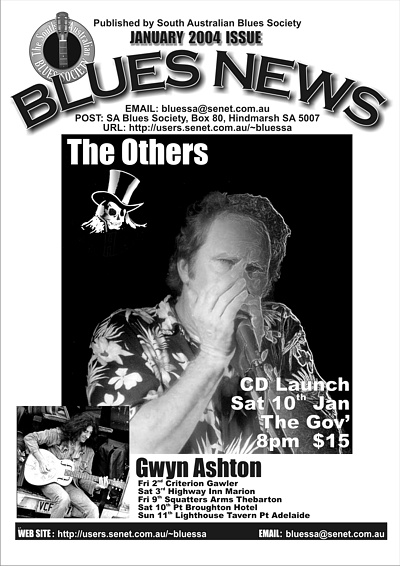
Blues News Jan 2004 PDF

Blues News Feb 2004 PDF
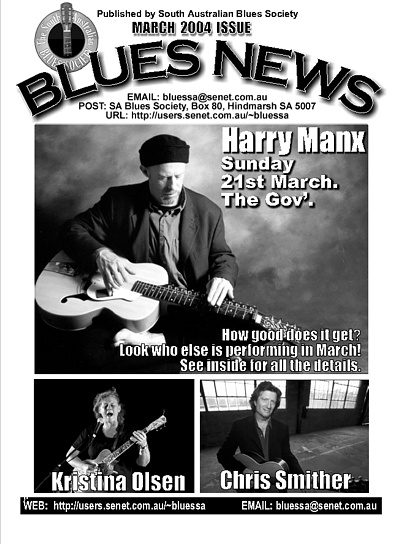
Blues News March 2004 PDF
For an hour and a half of the best in blues tune into BLUES POWER every Thursday evening from 7.30 (GMT+9.30) on Adelaide's Three D Radio, 93.7 FM
Stream here: http://www.threedradio.com/
Blog here:http://bluespoweradelaide.blogspot.com.au/
http://www.jplightandsound.com.au/
43 Beulah Road, Norwood, SA 5067
mobile: 0413 166 079
info@jplightandsound.com.au
Lighting | Sound | DJ Hire | Visual | Event Hire